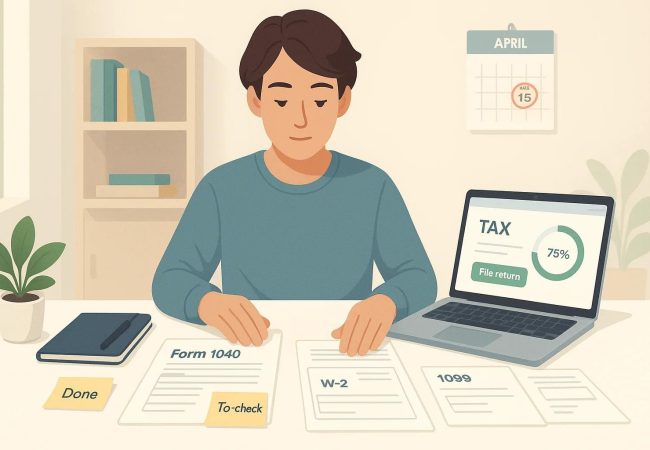
For most taxpayers, federal income tax withholding happens in the background. Taxes come out of each paycheck, and unless something changes with your employment, you may not give those amounts much thought.
But having taxes withheld doesn’t necessarily mean you’ve paid enough to cover your final tax liability.
As we approach the end of 2026, it’s worth taking a closer look at how much you’ve paid and whether any adjustments are needed before the year closes.
Why Your Withholding May No Longer Be Enough
When you complete Form W-4 for your employer, you’re providing information used to calculate how much federal income tax should be withheld from your wages.
That calculation doesn’t automatically account for every change in your financial situation.
For example, if you and your spouse both work, your withholding may need to reflect your combined income. Additional earnings from another job or investment income can also increase your tax liability without increasing the amount withheld from your regular paycheck.
This is particularly important if you haven’t updated your W-4 in several years. The information you provided when you started your job may no longer reflect your current circumstances.
Even if your wages haven’t changed, the amount you’re paying toward federal income taxes may not reflect what you’ll owe for 2026.
The opposite can also happen. If too much federal income tax is being withheld, you may receive a larger refund when you file. While that isn’t necessarily a bad thing, it means you’ve had less of your income available to you throughout the year.
What About Estimated Tax Payments?
Not everyone pays federal income taxes through payroll withholding.
Self-employed individuals and taxpayers with income that isn’t subject to withholding may need to make estimated tax payments throughout the year.
These payments are generally calculated using your expected income and tax liability. If your income has changed significantly, the estimates you originally calculated may need to be adjusted.
For the 2026 tax year, the fourth estimated tax payment is generally due January 15, 2027.
Don’t Overlook Underpayment Penalties
Many taxpayers don’t realize they can face an underpayment penalty even when they pay their tax balance in full by the April filing deadline.
For example, a self-employed taxpayer expects to owe $12,000 in federal income taxes for 2026. Instead of making estimated payments of approximately $3,000 each quarter, they wait until April 2027 to pay the full amount. By then, penalties may have been accumulating from the earlier payment deadlines.
However, penalties aren’t automatic. The IRS has safe-harbor rules that may protect taxpayers based on their current-year or prior-year tax liability. Other exceptions may also apply.
How Can You Tell Whether You’re on Track?
A good starting point is your most recent pay statement.
Look for the year-to-date federal income tax withholding amount. This tells you how much has been withheld from your wages so far in 2026.
Next, estimate how much additional federal income tax will be withheld from your remaining paychecks.
If you’re married and filing jointly, include your spouse’s withholding and expected income in that review.
You can then compare your anticipated total payments with your expected tax liability for the year.
Your 2025 tax return can help provide context. In particular, look at your total tax liability, rather than simply the refund you received or the balance you owed when you filed. Keep in mind that changes in income or deductions could make your 2026 liability different.
The IRS also offers a free Tax Withholding Estimator that can help taxpayers evaluate their withholding and determine whether adjustments to Form W-4 or W-4P may be appropriate.
For taxpayers with more complicated financial situations, a tax projection can provide a more complete picture.
Is There Still Time to Make Adjustments?
Yes, although the options available will depend on your circumstances.
If you receive wages, you may be able to update Form W-4 to increase the federal income tax withheld from your remaining paychecks. Certain pension recipients may also be able to adjust their withholding.
If you make estimated tax payments, you can review your projected liability and determine whether your remaining payment should change.
There is also an important difference in how these payments are treated for underpayment penalty purposes.
Federal income tax withholding is generally treated as though it was paid evenly throughout the year, while estimated tax payments are generally credited when they’re made.
This distinction can be especially important late in the year. Increasing withholding before December 31 may help address an earlier shortfall in some situations, even when making a late estimated payment would not have the same effect.
With the end of 2026 approaching, reviewing your tax payments now can help you determine whether adjustments are needed before the year closes.